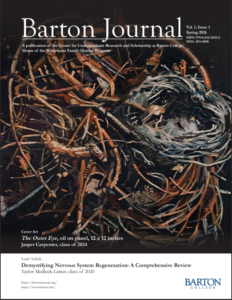

A Publication of the Center for Undergraduate Research and Scholarship at Barton College


Volume 1, No. 1
Online ISSN: 3071-0898

Copyright

© The authors. This article is published under the terms of the Creative Commons 4.0 License, which permits use, distribution and reproduction in any medium, provided the original work is properly cited.

Mind & Care Kits Initiative

CONFERENCE ABSTRACT

Morgan Harold*, Josephine Rodriguez*, Skylar Watkins*, and Ashley Gardner⁺

School of Health Sciences, Barton College, Wilson, NC, USA
*Student author, ⁺Faculty mentor


CITATION

Harold, Morgan; Rodriguez, Josephine; Watkins, Skylar, & Gardner, Ashley. (2026). Mind & care kits initiative [Conference abstract]. Barton Journal, 1(1), 194–195. https://bartonjournal.org/vol-1-no-1/2026-cat4-article-no-037


Abstract

Applying the Eight Dimensions of Wellness Framework, Mojo’s is a student-led initiative focused on improving mental well-being and reducing hygiene insecurity among students at Barton College. Many college students face financial stress and housing instability, which can limit their access to essential hygiene products and negatively impact their mental health, confidence, and academic performance (Nasr et al., 2024; Roy & Biswas, 2025).  Mojo’s proposes the Mind and Care Kits Initiative, which aims to assemble and distribute up to 100 hygiene kits containing toothbrushes, toothpaste, travel-size hygiene products, and handwritten encouragement notes to students experiencing financial hardship. These kits were distributed through accessible campus locations and partner offices in order to reduce stigma and increase reach. The goal of this project was to reduce hygiene insecurity, promote emotional well-being, and support students’ academic and personal success. Methods included bulk purchasing hygiene supplies, assembling kits, advertising via flyers and email, and hosting a campus distribution event. The total funding requested for this initiative was approximately $500. With support from campus partners and a clear evaluation plan, Mojo’s was committed to ensuring the kits were distributed effectively and positively impacted student well-being.

Keywords: mental health, hygiene, confidence, performance


References

Nasr, Ramona; Rahman, Abir Abdel; Haddad, Chadia; Nasr, Nada; Karam, Joanne; Hayek, Jessy; Ismael, Ibrahim; Swaidan, Eman; Salameh, Pascale; & Alami, Nael. (2024). The impact of financial stress on student wellbeing in Lebanese higher education. BMC Public Health, 24(1809), 1–13. https://doi.org/10.1186/s12889-024-19312-0

Roy, Sharmistha; Biswas, Ashis Kumar & Sharma, Manoj. (2025). Stress, anxiety, and depression as psychological distress among college and undergraduate students: A scoping review of reviews guided by the socio-ecological model. Healthcare, 13(16), 1–20. https://doi.org/10.3390/healthcare13161948 

Category I Articles
(3000–5000 words)

Full-length Article. Comprehensive, original research study common in the sciences, social sciences, humanities, and interdisciplinary fields. Presents research questions, methods, findings, and implications in full detail.

Review Article. Critical synthesis of existing scholarship across a discipline or subfield, often in the sciences, social sciences, and humanities. Identifies major debates, trends, and gaps in the literature.

Technical Report. Detailed account of applied research, development, or project-based work, typically used in engineering, technology, environmental science, and public policy. Emphasizes procedures, data, and practical results.

Category II Articles
(1500–3000 Words)

Case Study. An in-depth examination of a single event, individual, organization, or community, used widely in business, education, medicine, social sciences, and public policy to illustrate broader concepts.

Creative Scholarship. Scholarly work grounded in artistic, literary, or creative practices. Explores craft, process, or interpretation as a form of inquiry accompanied by explanatory text.

Critical Essay. An argument-driven analysis of a text, issue, or concept, common in the humanities and cultural studies. Prioritizes interpretation, critique, and original perspective.

Data Paper. Documentation-focused article describing a dataset’s collection, structure, and potential uses. Common in sciences, social sciences, and humanities.

Methodology Paper. Focused exploration of research methods, designs, or analytical tools across disciplines such as psychology, biology, statistics, and communication studies. Emphasizes innovation or refinement of methods.

Replication Study. Study that reproduces prior research to test reliability and validity, especially in psychology, economics, biomedical sciences, and education.

Research Note. Short report presenting preliminary findings, emerging questions, or early-stage results. Used in sciences and social sciences to share timely insights.Short article. Condensed research piece that presents a focused analysis, small study, or partial findings across disciplines.

Category III Articles
(750–1000 Words)

Book/Media Review. Evaluative overview of a recent book, film, performance, or digital media, used across humanities, social sciences, and interdisciplinary fields.

Brief. Concise report summarizing key findings, updates, or policy-relevant information, common in public policy, health, and applied sciences.

Commentary. Short, argument-based reflection on a current issue, debate, or publication, common across disciplines.

Letter. Short communication addressing a specific study, idea, or dataset, used in sciences, social sciences, and some humanities fields.

Perspective. Reflective or viewpoint-driven piece offering an informed disciplinary interpretation of an issue, trend, or method.

Category IV Articles
(Abstracts)

Extended Abstract (300–700 Words). A more detailed, mini-article format often used in STEM and interdisciplinary conferences, including background, methods, and preliminary findings.

Conference Abstract (150–300 Words). Concise summary of proposed conference research, outlining the question, approach, and significance across any academic discipline.