
CRITICAL ESSAY (Article PDF)
Eulalia Pascual Biosca* and Charles Lanier⁺
School of Business and Innovation, Barton College, Wilson, NC, USA
*Student author, ⁺Faculty mentor
CITATION
Pascual Biosca, Eulalia; & Lanier, Charles. (2026). Rivalytics: The role of marketing perception in shaping consumer loyalty in Nike and Adidas—Evidence from primary survey data. Barton Journal, 1(1), 127–134. https://bartonjournal.org/vol-1-no-1/2026-cat2-article-no-009
Abstract
Since 1964, Nike and Adidas have dominated the sports industry, developing a rivalry that extends beyond products and is now focused on building emotional branding to develop their desired consumer perception and achieve customer loyalty. This study addressed the role of marketing perception in influencing consumer loyalty. Using a quantitative research design, primary data was collected through an online survey designed to compare consumer perceptions. The survey was completed by 134 respondents, and sent exclusively to members of the college community with an official institutional email address. The survey was organized into five sections—demographics, financial performance, sponsorships, marketing strategy, and consumer perception—allowing for both quantitative and qualitative insights. Responses were analyzed and compared with real-world data, revealing the significant role that marketing plays when maintaining consumer loyalty. Findings within this sample reveal consumer perceptions of Nike and Adidas do not fully align with prevailing industry trends or global data. Many differences were identified regarding brand perception and consumer preferences. This suggests that within a specific consumer group, expected brand association may change. While the study includes a limited and demographic sample size, it demonstrates valuable outcomes for companies, reinforcing the necessity to continuously evaluate their message across different audience segments.
Key words: consumer loyalty, marketing, emotional branding, Adidas, Nike
Introduction
The rivalry between Nike and Adidas has always been influential within the modern sports wear industry. Each brand’s customer loyalty is a key to continuing as a leader in many worldwide sports markets. For instance, Adidas is the biggest sportswear manufacturer in Europe and second largest globally, following Nike (Han, 2025). Nevertheless, both brands go beyond athletic performance and play a significant role in streetwear fashion and cultural identity.
In today’s digital era, brand loyalty has adapted into a new form, known as emotional branding, a term introduced by Marc Gobé, focused on targeting customers’ emotions (Wong, 2024). It is a strategy where consumers engage with brands that transmit their values within their content, creating real relationships rather than just transmitting functional business benefits (Akgün et al., 2013). Therefore, digital platforms have also transformed marketing, focusing on creating relationships based on emotional storytelling and personalized engagement in order to create and shape loyalty. Within this context, the significance of the Nike and Adidas rivalry lies in its cultural and economic influence, as each brand deploys distinct strategies that shape modern marketing strategies and consumer engagement.
The purpose of this study was to analyze and compare how Nike and Adidas use digital ecosystems, emotional branding, and cultural positioning to construct consumer loyalty. This research incorporates primary data collected through a real survey conducted within a defined audience, with all collected data presented in a website specifically developed for the study. The central argument is that brand loyalty is no longer driven mainly by product superiority but by emotions, engagement and identity construction. Rivalytics research combines theoretical information with original survey data to analyze how Nike and Adidas compete for consumer loyalty and which areas dominate in today’s sport industry. The term Rivalytics, created for this study by merging rivalry and analytics, refers to a data-driven approach to understanding competitive brand relationships.
Contextual Framework and Scholarly Positioning
The rapid evolution of digital technology has changed the relationship between consumers and brands. Consumers are not only looking for products and services that solely meet their respective needs, but also to connect emotionally with brands and their mission. Within this context, the concept known as emotional branding becomes highly relevant. Emotional branding is a marketing strategy that seeks to create connections through storytelling, customer experience, and transmission of brand values. In other words, emotional branding strategies are a key factor to increase customer loyalty (Hasibuan et al., 2025). Without customer loyalty, all efforts to create deeper emotional connections with customers are useless, since the final objective would not have been achieved: to make purchases be constant and create an emotional commitment to the brand (Hasibuan et al., 2025).
Nike and Adidas are the two most popular sporting equipment companies in the world. In fiscal year 2024, Nike reported total revenues of approximately $51.4 billion (Nike, Inc., 2024), while Adidas generated about $23.6 billion in revenue (Adidas AG, 2025). Each brand’s image and perception are exceptional, and both companies have similar strategies and suppliers, making their rivalry more noticeable. Nike Inc, is an American multinational corporation mainly focused on the sports industry, selling footwear, apparel, equipment, accessories and services (Mahdi et al., 2015). Headquartered in Beaverton, Oregon (USA), and founded in 1964 as Blue Ribbon Sports, the company was officially renamed Nike, Inc. in 1971. Nike is the world’s leading sportswear company (Ozanian, 2013). According to Forbes, Nike accounts for over one-third of the athletic gear maker’s market value, dominating the international market through a powerful combination of performance-driven design, emotional storytelling, and digital marketing (Ozanian, 2013).
Nike follows many strategies in order to become a world leader in sports. One of these strategies is a continuous focus on innovation and research in order to produce and offer the best equipment to contribute to athletic performance, motivation and comfort (Mahdi et al., 2015). Moreover, Nike is a pioneer within this industry by using the Market Segmentation Strategy, an approach that advertises its products throughout strategic sponsorships with celebrity athletes, such as Michael Jordan, professional teams, and other college athletic teams (Mahdi et al., 2015). Beyond performance, the company emphasizes sustainability and social responsibility through many initiatives. According to its sustainability data, Nike has achieved a 96% renewable electricity coverage for its operations, as well as a 69% reduction of absolute emissions from operations (Sustainability, n.d.). Today, Nike stands as the most valuable sportswear brand globally, leading in both revenue and brand equity. Nike’s unique combination of innovation and inspiration continues to shape global sports culture, giving Nike a higher competitive advantage in the industry.
By comparison, Adidas, founded in 1949 in Germany, is also one of the most influential sportswear and lifestyle brands in the world. Adidas’s iconic three-stripes logo has become widely recognized across global markets. The company focuses more on differentiation and multi-brand strategies, with the aim of having a diverse brand portfolio, colliding the worlds of sports and fashion culture. This allows them to target all segments of the market, from professional athletes to everyday consumers (Mahdi et al., 2015). The brand maintains a strong presence in European markets, while also being represented internationally. This influence is especially visible in football (soccer) , where Adidas sponsors elite teams such as Real Madrid and FC Bayern Munich (Adidas, 2025). Beyond performance, Adidas has developed impactful marketing initiatives related to environmental responsibility, such as Parley for the Oceans, a shoe creation made from reclaimed marine plastic waste and recycled from ocean waste (Parley, 2023).
Adidas defines itself as a brand focused on generating innovative concepts that unite performance and culture, creating campaigns that positively influence social wellbeing in all possible ways. The insights previously obtained from the conceptual framework are used in Rivalytics to interpret and compare them with the primary data acquired in the research. Stated differently, the general market data have been considered to be a baseline of expected patterns regarding consumers’ perception and brand positioning about Nike and Adidas. These measures are compared with the data collected through the survey component of the study. This comparative analysis enables the detection of any deviations from the general expectations, allowing the study to highlight those shifts and demonstrate how individuals relate differently to the two brands within a specific context.
Argument Development
This section develops the core argument of the Rivalytics study by examining the research methodology, consumer loyalty patterns, emotional branding strategies, and marketing insights related to Nike and Adidas.
Research Design and Methodology
This survey-based research was conducted through an online survey designed to compare consumer perceptions of Nike and Adidas in relation to marketing strategies, brand image, and purchasing behavior. The survey was distributed through institutional email, exclusively to members of a small, liberal arts college with a high percentage of student-athletes. A total of 134 respondents completed the survey, with questions divided into five sections: demographics, financial performance, sponsorships, marketing strategy, and consumer perception. This design allowed for both quantitative and qualitative insights. Responses were analyzed to identify patterns in brand preference and perception between Nike and Adidas, and later compared with real-world data obtained from official brand reports, market analyses, and academic sources.
Consumer Loyalty Patterns — Survey Results
Survey data from 134 participants demonstrated a strong preference toward Nike. When forced to choose one brand, 70.9% selected Nike, while a smaller proportion preferred Adidas. Similarly, 60.4% reported purchasing Nike more frequently, reinforcing the brand dominance within the sample. Moreover, Nike obtained higher recommendation scores, between 4–5 range scale, and frequent purchasing behavior among its users, demonstrating stronger behavioral loyalty. Nevertheless, Adidas loyalty perception was tied to symbolic associations, as its consumers showed more attachment in the lifestyle and comfort-oriented areas. When focusing on the research pattern-based observations, loyalty appears to be controlled by perception rather than external promotions. Product quality and performance still dominates over any collaboration with celebrities and athletes, as data showed that sponsorship influence is minimal (<30%).
Open-ended responses allowed the research to develop a more critical interpretation of the perceptions of each brand. The data connected Nike with an athletic self-identity, linking athletic excellence, iconic athletes, and performance with the brand. One respondent described Nike as “more consistent and friendlier to larger individuals,” reinforcing the perception of Nike as a brand that not only focuses on performance, but also resonates with a broader range of consumers. However, Adidas data was more associated with comfort and fashion, indicating a lifestyle brand image. As one participant explained, Adidas is “more about everyday style rather than intense performance.”
Emotional Branding and Identity Construction — Evidence from Data
Nike dominates the international market by staying true to its mission: bring continuous inspiration and motivation (Nike Inc., n.d). This message is constantly reinforced in most of the content to create a whole brand voice around performance and empowerment. In fact, Nike has a specific focus on motivational storytelling; for instance, using campaigns such as Just Do It and Winning Isn’t for Everyone to inspire personal improvement and athletic achievement (Samadji, 2024). Although most of Rivalytics participants (85.8%) stated that marketing campaigns do not influence their purchases much, 44.8% viewed Nike campaigns as more motivating. Taking this into consideration, survey patterns closely reflected Nike’s association with inspiration and athletic performance, as respondents view the brand as a symbol of personal achievement and self-improvement in the sports field.
When evaluating Adidas’s emotional associations, it is important to focus on the areas the audience connects this brand with: soccer, comfort, and fashion. Adidas is internationally recognized for blending sport with fashion, lifestyle, and cultural expression, often driven by collaborations with designers, musicians, and influencers (Vizologi, 2025). The research findings reinforced earlier observations, as a large majority of respondents (76.9%) viewed Adidas’s advertising as more creative and aligned with fashion, lifestyle and cultural identity.
Rivalytics insights revealed a surprising contradiction to the general research trends. An important part of Adidas’s reputation relies on its sustainability initiatives, such as its Parley recycled polyester products, attracting trend-conscious and environmentally aware consumers (Parley, 2023). Nonetheless, the research sustainability perception was weaker than expected. As shown in Figure 3, 71.6% of respondents did not strongly associate Adidas with environmental leadership. The emotional drivers that correlate most with loyalty were performance perception linked to Nike, and lifestyle identity strongly associated with Adidas. In other words, this demonstrates that most of the consumer loyalty patterns in the survey aligned closely with global data. In view of the previously examined data, brands focus beyond product value. Brands seek emotional meaning to create their desired perception to customers, thus indirectly building brand loyalty and preference.
Data-Driven Marketing and Consumer Behavior Insights
Research data shows that Nike and Adidas have distinct marketing strategies, each designed to target specific audience connections. It was possible to observe behavioral differences in loyalty within consumers of each brand. On one hand, Nike-loyal consumers are performance-oriented, with a higher repeat purchase frequency and are less influenced by sponsorship and more by product performance. On the other hand, Adidas-loyal consumers are more lifestyle and comfort-driven, with a lower purchase frequency but with a strong positioning in the lifestyle and cultural industry.
Considering the data from the Rivalytics research, three consumer segments can be identified: performance-driven buyers, fashion-oriented buyers, and a mix of both, the quality-driven buyers. According to the demographic data of the study, many of the respondents identified as people who consider the two main categories equally. Nevertheless, particular attention should be given to the results about marketing campaigns in the research. Most participants (85.8%) stated that marketing campaigns do not influence their purchases more than product quality. Even though respondents make this claim, they are still aware of the brand’s mission, its innovations, and recent actions, demonstrating a long-term influence on their consumer behavior.
Comparative Strategic Interpretation & Outcomes
The outcomes highlight Nike as the brand with the strongest emotional loyalty, supported by the primary data, in having a higher preference (70.9%), recommendation scores and identity alignment with the audience. However, Adidas demonstrated being the strongest in cultural and lifestyle identification. The brand has the highest perception of creativity and fashion alignment (76.9%), strongly associated with lifestyle within its target consumers and a present community involvement.
Counterarguments, Limitations, and Complications
A counterargument throughout the research can be seen in the main drivers of loyalty. A combined 71.6% and 58.2% of respondents prioritized comfort, performance and price, respectively (Figure 1). Therefore, despite the rise of emotional branding, product performance and price are still the main factors in customer decision-making.
Figure 1
Main Factors Influencing Consumer Purchase Decisions In The Sports Industry
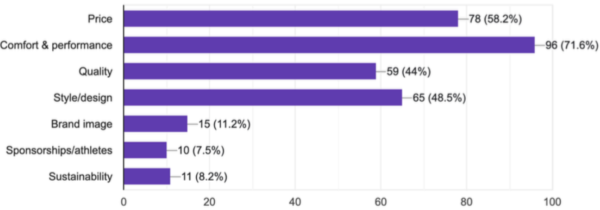
Note: Data collected through original survey conducted for the Rivalytics study (N = 134).
This study presents several limitations that should be considered. First, the primary data reflects responses from 134 participants drawn from a small, private, liberal arts college, representing the perspectives of a defined population within a particular academic setting. Second, the research focuses exclusively on Nike and Adidas, therefore, the findings are difficult to generalize into the sportswear industry as a whole. Additionally, the survey was only conducted within the U.S, although a few participants were from other countries, meaning that cultural and geographical differences among consumers were not perfectly captured within the study’s sample. Finally, it needs to be noted that the rapid evolution of today’s digital environment will affect marketing strategies, thus, the future applicability of Rivalytics. Rivalytics’ findings offer insights into how to shape broader implications and its future directions. The study provides strategic primary data on customer perception of the two main brands, therefore, deepening the role of data analytics in this study may be a long-term direction to use those results to strengthen customer engagement and behavior. Future research should explore the growing role of AI, especially in consumer personalization, with the aim of focusing on how machine learning, predictive analytics, and real-time behavioral data enable brands to deliver highly customized experiences.
Conclusion
This project argues that the rivalry between Nike and Adidas reveals how today’s brand competition is driven not only by marketing strategy and performance, but by emotional branding, identity brand construction, and data-driven consumer insight, which support the development of loyalty in the long run. Key findings indicate that consumers are influenced by how effective brands are in positioning themselves, transmitting their brand message and narrative. Furthermore, in order to build the strong community of loyal consumers that every company seeks, the study demonstrates that product quality, effective emotional branding, and identity-based perception are key drivers of brand preference over competitors in the market.
Rivalytics results reveal that brand perception within a small, focused audience does not always align and may diverge from global market expectations. Therefore, these findings not only highlight the importance of collecting specialized and segmented consumer data rather than relying solely on macro-level brand positioning, but also illustrates the need for companies to continually evaluate how their message and mission resonate with specific audience segments. Nike and Adidas have always been dominant brands in the global sports industry. They compete not just through their product and service offerings, but also through the messages they create around their brands. Their rivalry surpasses product performance, focusing on building emotional connections and influencing how consumers view themselves through the brand. Understanding the Rivalytics framework requires recognizing that today’s brand loyalty reflects community belonging that goes beyond functional or economic value.
References
Adidas. (n.d.). Annual report 2024. Adidas. https://report.adidas-group.com/2024/en/ group-management-report-our-company/description-of-business-model/product-and-mar keting.html
Adidas AG. (2025, March 5). Adidas reports strong results for 2024 and expects top- and bottom-line momentum to continue in 2025. Adidas. https://www.adidas-group.com/en/ media/press-releases/adidas-reports-strong-results-for-2024-and-expects-top-and-bottom line-momentum-to-continue-in-2025
Akgün, Ali Ekber, Koçoğlu, İpek, & İmamoğlu, Salih Zeki. (2013). An emerging consumer experience: Emotional branding. Procedia – Social and Behavioral Sciences, 99, 503–508. https://doi.org/10.1016/j.sbspro.2013.10.519
Han, Xingyu. (2025). Comparison of marketing strategies between Nike and Adidas. Highlights in Business, Economics and Management, 60, 215–221. https://doi.org/10.54097/2rxvyw17
Hasibuan, Ahmad Nurdin, Laksono, Rudi., Limakrisna, Nandan., & Moeins, Anoesyirwan. (2025). Influence Of Emotional Branding On Customer Loyalty In The Digital Era. Procedia Environmental Science, Engineering and Management, 12(1). https://www.procedia-esem.eu/pdf/issues/2025/no1/5_Hasibuan_25.pdf
Mahdi, Hussain. A. Ali., Abbas, Mohammed., Mazar, Taher. Ilyas., & George, Shaju. (2015). A comparative analysis of strategies and business models of Nike, Inc. and Adidas Group with special reference to competitive advantage in the context of a dynamic and competitive environment. International Journal of Business Management and Economic Research, 6(3), 167-177. https://www.semanticscholar.org/paper/A-Comparative-Analysis-of-Strategies-and-Busin ess-%2C-Mahdi-Abbas/b0a72e2fb2b7d23121895f1582289a221229c91c
Nike, Inc. (n.d.). About Nike. Nike, Inc. https://about.nike.com/en/mission/ Nike, Inc.
Nike, Inc. (2024, June 27). NIKE, Inc. reports fiscal 2024 fourth quarter and full year results. Nike, Inc. https://investors.nike.com/investors/news-events-and-reports/investor-news/investor-news-details/2024/NIKE-Inc.-Reports-Fiscal-2024-Fourth-Quarter-and-Full-Year-Results/default.aspx
Nike, Inc. (n.d.). Sustainability. https://about.nike.com/en/mission/focus-areas/sustainability
Ozanian, Mike. (2013, March 26). The Forbes Fab 40: The world’s most valuable sports brands. Forbes. https://www.forbes.com/sites/mikeozanian/2012/10/17/the-forbes-fab-40-the-worlds-mos t-valuable-sports-brands-4/?ctpv=searchpage
Parley. (2023, June 15). Adidas X Parley Parley. https://parley.tv/initiatives/adidasxparley
Vizologi. (2025, July 23). What is the target market of Nike and Adidas?. Vizologi. https://vizologi.com/what-is-target-market-of-nike-and-adidas/
Wong, Jessica. (2024, December 5). Emotional Branding—Connecting With Consumers On A Deeper Level. Forbes. https://www.forbes.com/councils/forbescommunicationscouncil/2024/12/05/emotional-branding-connecting-with-consumers-on-a-deeper-level/