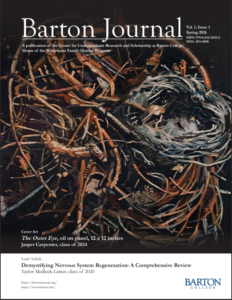

A Publication of the Center for Undergraduate Research and Scholarship at Barton College


Volume 1, No. 1
Online ISSN: 3071-0898

Copyright

© The authors. This article is published under the terms of the Creative Commons 4.0 License, which permits use, distribution and reproduction in any medium, provided the original work is properly cited.

The Effects of Sleep Quantity and Quality on Athletic Performance and Recovery

CONFERENCE ABSTRACT

Christopher “Walt” Williams* and Lauren Biscardi⁺

School of Health Sciences, Barton College, Wilson, NC, USA
*Student author, ⁺Faculty mentor


CITATION

Williams, Christopher Walt; & Biscardi, Lauren. (2026). The effects of sleep quantity and quality on athletic performance and recovery [Conference abstract]. Barton Journal, 1(1), 176–177. https://bartonjournal.org/vol-1-no-1/2026-cat4-article-no-028


Abstract

The importance of optimizing sleep has increased significantly in recent years regarding athletic performance and recovery. However, many athletes struggle to achieve sufficient sleep quantity or quality. This narrative review examines the links among sleep duration, sleep quality, and targeted sleep interventions designed to enhance athletic performance and recovery. This review also investigates the effects of inadequate sleep on physiological and psychological performance, and analyzes how targeted sleep strategies may improve athletic outcomes. This narrative review relied on a range of peer-reviewed journal articles in sports medicine and exercise science. Selected sources addressed sleep-related interventions, effective sleep hygiene, or the influence of training and competition on athletes’ sleep. By incorporating systematic reviews, meta-analyses, and observational studies, this review thoroughly explores the effects of sleep habits on athletic performance, recovery, and athletes’ health. Findings from the research indicate that suboptimal sleep will negatively affect an athlete’s reaction time, cognitive abilities, mood, and performance, as well as an athlete’s ability to recover from injury or training. Conversely, interventions including extending sleep, practicing better sleep hygiene, and using strategic napping techniques have demonstrated improvement in both athletic performance and recovery. In addition to the above-mentioned interventions, other variables (training load, travel schedule, competition schedule) might have an impact on disrupting an athlete’s ability to get adequate amounts of sleep. Ultimately, this review supports the concept of sleep being an easily modified variable that can be utilized by coaches and athletes to maximize athletic performance and maintain a healthy lifestyle.

Keywords: sleep, athletes, human performance, recovery

Category I Articles
(3000–5000 words)

Full-length Article. Comprehensive, original research study common in the sciences, social sciences, humanities, and interdisciplinary fields. Presents research questions, methods, findings, and implications in full detail.

Review Article. Critical synthesis of existing scholarship across a discipline or subfield, often in the sciences, social sciences, and humanities. Identifies major debates, trends, and gaps in the literature.

Technical Report. Detailed account of applied research, development, or project-based work, typically used in engineering, technology, environmental science, and public policy. Emphasizes procedures, data, and practical results.

Category II Articles
(1500–3000 Words)

Case Study. An in-depth examination of a single event, individual, organization, or community, used widely in business, education, medicine, social sciences, and public policy to illustrate broader concepts.

Creative Scholarship. Scholarly work grounded in artistic, literary, or creative practices. Explores craft, process, or interpretation as a form of inquiry accompanied by explanatory text.

Critical Essay. An argument-driven analysis of a text, issue, or concept, common in the humanities and cultural studies. Prioritizes interpretation, critique, and original perspective.

Data Paper. Documentation-focused article describing a dataset’s collection, structure, and potential uses. Common in sciences, social sciences, and humanities.

Methodology Paper. Focused exploration of research methods, designs, or analytical tools across disciplines such as psychology, biology, statistics, and communication studies. Emphasizes innovation or refinement of methods.

Replication Study. Study that reproduces prior research to test reliability and validity, especially in psychology, economics, biomedical sciences, and education.

Research Note. Short report presenting preliminary findings, emerging questions, or early-stage results. Used in sciences and social sciences to share timely insights.Short article. Condensed research piece that presents a focused analysis, small study, or partial findings across disciplines.

Category III Articles
(750–1000 Words)

Book/Media Review. Evaluative overview of a recent book, film, performance, or digital media, used across humanities, social sciences, and interdisciplinary fields.

Brief. Concise report summarizing key findings, updates, or policy-relevant information, common in public policy, health, and applied sciences.

Commentary. Short, argument-based reflection on a current issue, debate, or publication, common across disciplines.

Letter. Short communication addressing a specific study, idea, or dataset, used in sciences, social sciences, and some humanities fields.

Perspective. Reflective or viewpoint-driven piece offering an informed disciplinary interpretation of an issue, trend, or method.

Category IV Articles
(Abstracts)

Extended Abstract (300–700 Words). A more detailed, mini-article format often used in STEM and interdisciplinary conferences, including background, methods, and preliminary findings.

Conference Abstract (150–300 Words). Concise summary of proposed conference research, outlining the question, approach, and significance across any academic discipline.