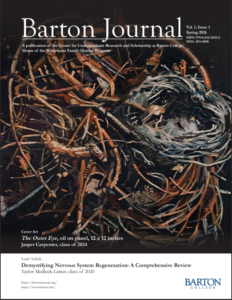

A Publication of the Center for Undergraduate Research and Scholarship at Barton College


Volume 1, No. 1
Online ISSN: 3071-0898

Copyright

© The authors. This article is published under the terms of the Creative Commons 4.0 License, which permits use, distribution and reproduction in any medium, provided the original work is properly cited.

Correlation Between Linear Sprint Speed and Force Production

CONFERENCE ABSTRACT

Nathan Waldridge* and Lauren Biscardi

School of Health Sciences, Barton College, Wilson, NC, USA
*Student author, ⁺Faculty mentor


CITATION

Waldridge, Nathan; & Biscardi, Lauren. (2026). Correlation between linear sprint speed and force production [Conference abstract]. Barton Journal, 1(1), 165–166. https://bartonjournal.org/vol-1-no-1/2026-cat4-article-no-022


Abstract

Linear sprinting is essential for athletic performance, especially in sports that require rapid acceleration and top-end speed. Force production is a known contributor to sprinting ability; however, the specific roles of horizontal and vertical force across sprint phases are not fully understood. This study aimed to examine the relationship between linear sprint speed and force production in college baseball players, hypothesized that horizontal force would better predict acceleration, and vertical force would better predict maximal velocity. Thirty male collegiate baseball players (ages 18–24) participated in this correlational study. Acceleration was measured using a 10-yard dash, while maximal velocity was assessed with a 10-yard fly sprint, following a 20-yard build-in. Horizontal force production was evaluated using countermovement and pause broad jumps. Vertical force production was measured using countermovement and pause vertical jumps. The stretch-shortening cycle (SSC) was assessed by comparing countermovement and pause conditions. Sprint times were recorded with Brower timing gates, and jump performance was measured using jump mats. Pearson correlations were used to examine relationships between sprint and jump variables, and paired t-tests compared jump conditions. Statistical significance was set at α = .05. Strong, significant negative correlations were found between 10-yard sprint times and all jump measures, indicating that greater force production corresponded with faster acceleration. Correlations ranged from r = -0.66 to r = -0.72 (p < .001). The 10-yard fly sprint also showed moderate-to-strong negative correlations with all jump variables (r = -0.55 to -0.61, p ≤ .002), suggesting that both horizontal and vertical force production contribute to maximal velocity. A moderate positive relationship was observed between eccentric utilization ratio (EUR) in the broad jump and maximal velocity (r = 0.48, p = .007). Additionally, countermovement jumps produced significantly greater distances and heights than pause jumps in both horizontal and vertical conditions (p < .001), demonstrating the benefit of SSC utilization. Force production was found to be strongly associated with both acceleration and maximal sprint speed. While horizontal force plays a key role in acceleration, vertical force also contributes meaningfully across sprint phases. The SSC enhances force output and should be incorporated into training. Overall, a combination of horizontal, vertical, and SSC-focused training methods is recommended to optimize sprint performance.

Keywords: athletic performance, force production, vertical force


Category I Articles
(3000–5000 words)

Full-length Article. Comprehensive, original research study common in the sciences, social sciences, humanities, and interdisciplinary fields. Presents research questions, methods, findings, and implications in full detail.

Review Article. Critical synthesis of existing scholarship across a discipline or subfield, often in the sciences, social sciences, and humanities. Identifies major debates, trends, and gaps in the literature.

Technical Report. Detailed account of applied research, development, or project-based work, typically used in engineering, technology, environmental science, and public policy. Emphasizes procedures, data, and practical results.

Category II Articles
(1500–3000 Words)

Case Study. An in-depth examination of a single event, individual, organization, or community, used widely in business, education, medicine, social sciences, and public policy to illustrate broader concepts.

Creative Scholarship. Scholarly work grounded in artistic, literary, or creative practices. Explores craft, process, or interpretation as a form of inquiry accompanied by explanatory text.

Critical Essay. An argument-driven analysis of a text, issue, or concept, common in the humanities and cultural studies. Prioritizes interpretation, critique, and original perspective.

Data Paper. Documentation-focused article describing a dataset’s collection, structure, and potential uses. Common in sciences, social sciences, and humanities.

Methodology Paper. Focused exploration of research methods, designs, or analytical tools across disciplines such as psychology, biology, statistics, and communication studies. Emphasizes innovation or refinement of methods.

Replication Study. Study that reproduces prior research to test reliability and validity, especially in psychology, economics, biomedical sciences, and education.

Research Note. Short report presenting preliminary findings, emerging questions, or early-stage results. Used in sciences and social sciences to share timely insights.Short article. Condensed research piece that presents a focused analysis, small study, or partial findings across disciplines.

Category III Articles
(750–1000 Words)

Book/Media Review. Evaluative overview of a recent book, film, performance, or digital media, used across humanities, social sciences, and interdisciplinary fields.

Brief. Concise report summarizing key findings, updates, or policy-relevant information, common in public policy, health, and applied sciences.

Commentary. Short, argument-based reflection on a current issue, debate, or publication, common across disciplines.

Letter. Short communication addressing a specific study, idea, or dataset, used in sciences, social sciences, and some humanities fields.

Perspective. Reflective or viewpoint-driven piece offering an informed disciplinary interpretation of an issue, trend, or method.

Category IV Articles
(Abstracts)

Extended Abstract (300–700 Words). A more detailed, mini-article format often used in STEM and interdisciplinary conferences, including background, methods, and preliminary findings.

Conference Abstract (150–300 Words). Concise summary of proposed conference research, outlining the question, approach, and significance across any academic discipline.